

What Types of Façade Defects Can Drone Inspections Detect in Dubai?
Key Takeaways
- Drones can identify visible glass cracks, sealant failure, cladding deformation, panel displacement and corrosion.
- Thermal imaging can support water ingress and moisture intrusion investigations.
- A drone cannot confirm every hidden or structural defect by itself.
- Nickel sulphide inclusion can cause spontaneous breakage in thermally toughened glass, but the microscopic inclusion itself cannot normally be diagnosed using a standard drone camera.
- A useful inspection turns aerial images into defect locations, technical findings and practical next steps.
- Dubai’s 2026 building safety law specifically includes the integrity of exterior cladding within the technical assessment of qualifying buildings.
Introduction
A façade can look perfectly fine from the pavement while problems are already developing several floors above. A small crack in glass, a failed sealant joint or a displaced cladding panel may be difficult to see clearly from the ground, especially on a high-rise building.
This is where façade defects drone inspection Dubai services can make a practical difference. A professional drone can capture high-resolution images of hard-to-reach exterior areas, helping inspection teams identify visible defects without immediately installing scaffolding or arranging rope access. Thermal imaging can add another layer of information where moisture or temperature differences need investigation.
But what can a drone actually detect? And what still requires close physical or engineering assessment? For the full process, including planning, capture, thermal imaging and reporting, see our drone facade inspection guide. Here, let’s break down the defect types specifically.
Let’s break it down.
What Façade Defects Can Drone Inspections Detect?
The short answer is: many visible exterior defects, but not every hidden building problem.
A drone inspection is particularly useful for surveying large façade areas and documenting defects that can be seen from a suitable aerial viewpoint. Baseera 360 lists glass cracks, sealant failures, moisture entry points, loose panels, corroded fixings, cladding deformation and corrosion among the issues its drone façade inspections can identify.
Defect | Visual Drone Inspection | Thermal Imaging | Further Assessment May Be Needed |
Glass cracks | ✓ | Sometimes | If cause or safety needs confirmation |
Sealant deterioration | ✓ | Sometimes | Often |
Loose/displaced panels | ✓ if visible | Limited | Yes |
Visible corrosion | ✓ | Limited | Often |
Water ingress | Signs may be visible | ✓ Useful | Often |
Thermal bridging | Limited | ✓ | As required |
Spalling | ✓ | Limited | Often |
Hidden anchor failure | Limited | No | Yes |
Hidden delamination | Limited | Sometimes useful | Yes |
This distinction matters. Building defect detection drone technology is excellent at collecting evidence, but the evidence still needs the right technical interpretation.
Glass Crack Detection Drone Inspections
Glass is one of the most important façade components on many Dubai towers. A glass crack detection drone survey can record visible cracks, damaged panes, edge damage and other glazing issues across elevations that would otherwise be difficult to inspect.
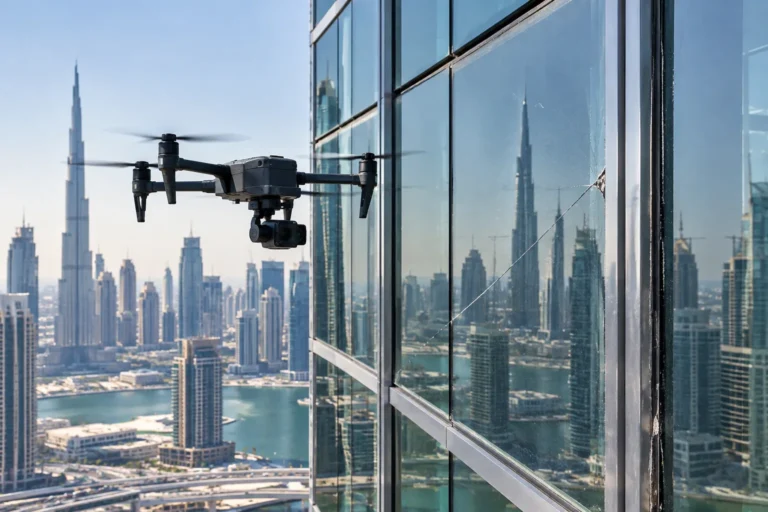
High-resolution imagery is especially useful when the inspection team needs to locate a defect precisely rather than simply report that a building has damaged glass.
Spontaneous Glass Breakage and Nickel Sulphide Inclusion
There is an important technical point here.
Nickel sulphide inclusions are microscopic inclusions that can contribute to spontaneous breakage in thermally toughened glass. Research has established that phase changes within NiS inclusions can create stresses that may eventually lead to glass failure.
However, we should not overstate what drone technology can do.
A standard drone camera cannot directly identify a microscopic nickel sulphide inclusion inside intact glass. It can document the resulting broken pane, crack pattern or visible glazing damage, which may then require specialist investigation.
That distinction is important when assessing spontaneous glass breakage.
Sealant Failure and Weatherproofing Degradation
Sealants play an important role in keeping façade joints weather-resistant. Over time, they can crack, shrink, separate from adjoining surfaces or lose their ability to perform as intended.
A drone can help identify visible signs of:
- Sealant failure
- Joint gaps
- Cracking
- Separation
- Deteriorated sealant
- Visible weatherproofing problems
Baseera 360’s published Dubai inspection work includes façade joint and sealant deterioration findings. In a 46-floor tower near DIFC, the inspection identified degraded façade joints and highlighted locations of sealant deterioration for targeted corrective action.
This is a good example of why defect mapping matters. Finding the affected areas allows maintenance teams to focus their attention where it is actually needed.
Cladding Deformation and Panel Displacement
Cladding can develop visible deformation, misalignment or displacement over time.
A cladding deformation detection inspection can look for:
- Bulging panels
- Misalignment
- Open joints
- Visible movement
- Damaged panels
- Panel displacement
- Surface deterioration
Drones are particularly useful for surveying large areas of cladding consistently.
However, seeing a displaced panel does not automatically explain why it moved. The underlying fixing system, anchors and supporting structure may require closer inspection.
Dubai’s 2026 building safety law specifically requires technical assessment reports to address the integrity of exterior cladding for buildings covered by the law.
Corrosion of Fixings and Anchors
Visible corrosion can appear around metal components, fixings and façade interfaces.
A high-resolution drone survey may document:
- Rust staining
- Visible corroded fixings
- Deteriorated metal surfaces
- Corrosion around joints
- Signs of material deterioration
But there is a clear limit: a drone cannot reliably confirm hidden anchor corrosion behind a cladding system simply because the external surface looks intact.
Where fixing integrity is important to safety, the aerial finding should lead to suitable engineering or physical assessment.
Water Ingress and Moisture Intrusion
Water-related façade problems can be particularly difficult to trace because the visible stain inside a building may not be directly below the actual entry point.
Visual drone inspection can identify possible external causes such as:
- Failed sealant
- Open joints
- Damaged cladding
- Staining
- Deteriorated weatherproofing
- Visible gaps
Planning a façade inspection in Dubai?
Thermal Imaging for Water Ingress
Water ingress drone thermal inspection can add useful information by identifying unusual temperature patterns associated with moisture or other building-envelope conditions.
Thermal imaging is not simply a heat camera pointed at a wall. Weather, surface material, sunlight and inspection timing can all affect readings. The result therefore needs professional interpretation.
Baseera 360 describes its thermal imaging service as being used to investigate trapped moisture, insulation issues, thermal bridging and water ingress.
Thermal Bridging and Insulation Issues
Thermal bridging occurs where heat moves through part of a building envelope more readily than through surrounding areas.
Thermal imaging may reveal temperature patterns that indicate an area deserves closer investigation.
It can be useful for assessing:
- Possible thermal bridges
- Insulation irregularities
- Moisture-related anomalies
- Temperature differences around façade components
The important point is that a thermal anomaly is a finding to investigate, not automatic proof of a specific construction defect.
Curtain Wall and Insulated Glass Unit Problems
Modern Dubai towers often use glass curtain wall systems, which contain several components working together.
Curtain Wall Defects
Drone inspection can help document visible:
- Sealant deterioration
- Glass damage
- Joint problems
- Panel misalignment
- Surface deterioration
- Visible framing issues
Insulated Glass Unit Failure
For an insulated glass unit failure, drones may record visible symptoms such as condensation or fogging between panes.
However, identifying the symptom is different from proving the exact cause of the failure. Further inspection may be required to assess the glazing unit and its seal.
Delamination and Spalling
Concrete and rendered façades can develop cracks, delamination or spalling.
Drone imagery may help identify:
- Surface cracking
- Missing surface material
- Areas of visible spalling
- Discolouration
- Localised deterioration
- Potentially loose material
These findings can be particularly important on tall buildings because detached façade material can create a safety risk below.
Again, aerial imagery should be treated as the first stage of assessment where the extent or cause of the defect is uncertain.
What Drone Inspection Cannot Confirm Alone
This is where a professional article needs to be clear.
A drone is primarily a remote visual and data-collection tool. It does not automatically prove:
- Hidden structural damage
- Internal anchor failure
- Microscopic glass inclusions
- Material strength
- Structural capacity
- Exact moisture source
- Hidden delamination
- The full cause of a façade failure
Where necessary, the inspection should lead to engineering review, close physical inspection or suitable non-destructive testing.
That is not a weakness of drone inspection. It is simply the correct way to use the technology.
How Are Façade Defects Recorded?
A useful inspection should follow a simple process:
Capture → Review → Locate → Classify → Assess → Recommend
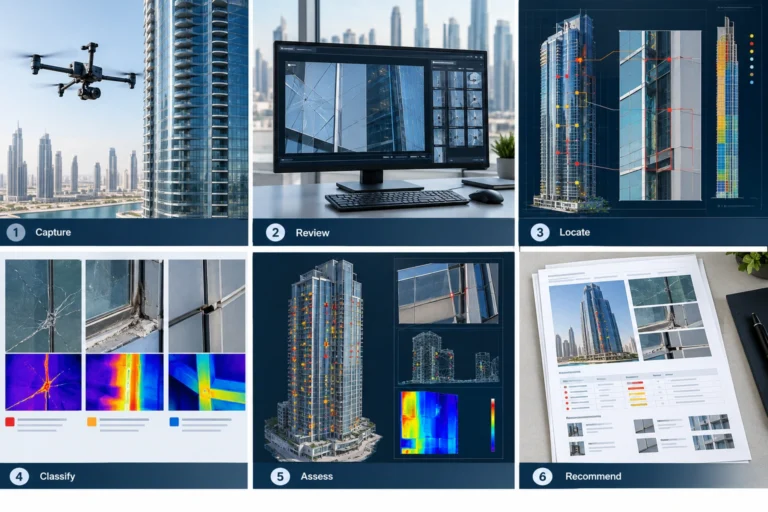
The final record may include:
- High-resolution photographs
- Defect locations
- Façade elevations
- Defect categories
- Severity or priority observations
- Thermal images where applicable
- 3D information where required
- Recommendations for further investigation or repair
The aim is to give the building team information they can actually use.
A Real Dubai Example
A published Baseera 360 case study provides a useful example.
The team inspected a 235-metre mixed-use high-rise tower on Sheikh Zayed Road, Dubai. The inspection focused on façade sections including glass panels and sealant systems. The assessment identified deterioration of stack-joint gaskets and issues affecting several glass panels. A technical evaluation and repair recommendations were then provided.
This illustrates the practical role of building defect detection drone services: collect detailed exterior evidence, identify areas of concern and provide information that supports technical decisions.
When Should You Arrange a Drone Façade Inspection?
A survey is worth considering when you notice:
- Cracked or damaged glass
- Possible loose panels
- Deteriorated sealants
- Repeated water leakage
- Corrosion staining
- Visible façade cracks
- An ageing façade
- Damage after an external event
- A need to document repair areas
- A preventive façade maintenance requirement
For a large tower, the value is not only in finding one visible defect. A systematic survey can show whether similar problems exist across other elevations.
A Better Way to Read Façade Defects
A drone inspection should answer three practical questions:
What is wrong? Where is it? What needs to happen next?
That is the real value of façade defects drone inspection Dubai services. High-resolution aerial imagery can make hard-to-reach exterior areas easier to document, while thermal imaging and other inspection tools can add useful information where visual evidence alone is not enough.
For building owners and facility teams, the goal should not be to collect more photographs. The goal should be to create clear, traceable evidence that supports safer and better maintenance decisions.
Need to Check Your Building Façade?
If your building has visible façade damage, recurring water leakage, ageing sealants or concerns about cladding and glazing, a professional drone survey can provide a practical first assessment. Baseera 360 combines drone façade inspection with thermal imaging, 3D modelling and engineering expertise to support façade condition assessment and maintenance planning.