

Thermal Imaging for Building Façades in Dubai: Detecting Hidden Moisture, Insulation Loss & Water Ingress
Key Takeaways
- Thermal imaging façade inspection in Dubai uses infrared sensors to determine variations in temperature of the surface. Thermal patterns can help locate areas associated with potential moisture, water ingress, insulation loss and thermal bridging.
- Radiometric thermal imaging provides temperature data that can be analysed rather than relying only on image colours.
- Weather, sunlight, wind, surface material and emissivity can affect thermal results.
- A drone thermal building inspection can cover difficult-to-access exterior areas efficiently, subject to suitable operating conditions and approvals.
- Thermal findings should be interpreted by qualified professionals and may need confirmation through other inspection methods.
Introduction
A façade can look perfectly fine from the ground and still have a problem behind the surface.
Moisture, poor insulation, thermal bridging and early water ingress do not always leave obvious marks. This is why thermal imaging façade inspection Dubai is becoming a useful part of modern building assessment. By recording infrared radiation and showing temperature differences across surfaces, thermography can help inspectors find areas that deserve closer attention.
When thermal cameras are combined with a drone, large or difficult-to-reach façades can be surveyed without sending an inspector to every external area immediately. But there is an important distinction: a thermal image shows a thermal anomaly, not automatic proof of its cause.
Let’s break down how this technology works, what it can reveal and where it fits into professional façade inspection.
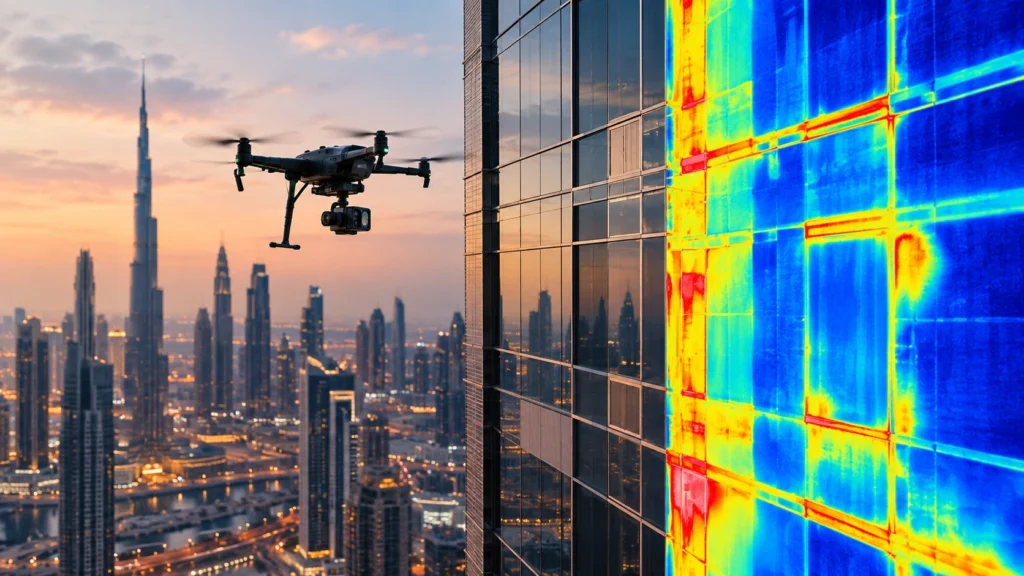
Table of Contents
What Is Thermal Imaging for Building Façades?
Thermal imaging is a non-contact inspection method that records infrared radiation from a surface and converts temperature differences into a visible thermal image.
For a building façade, this can help reveal areas behaving differently from surrounding materials. A thermal anomaly may indicate moisture, a change in insulation, thermal bridging or another condition that deserves investigation.
It does not mean that a camera can simply see through a wall.
Instead, the camera records surface temperature patterns. The inspector then considers those patterns alongside the building’s materials, weather conditions, orientation and visual condition.
The ISO 6781-1:2023 standard covers infrared thermographic methods for identifying heat, air and moisture irregularities in buildings and also highlights the importance of equipment, operator qualifications, analysis and reporting.
Thermal Imaging vs Ordinary Photography
Visual Inspection | Thermal Inspection |
Records visible defects | Records infrared temperature patterns |
Useful for cracks and surface damage | Useful for thermal anomalies |
Shows what the surface looks like | Shows how temperature varies across the surface |
Relies on visible light | Uses infrared radiation |
May miss hidden moisture indicators | Can identify areas requiring moisture investigation |
The strongest inspection does not necessarily choose one over the other. Visual and thermal images work better together.
Why Thermal Imaging Matters for Dubai Buildings
Dubai’s buildings operate under demanding environmental conditions. Strong sunlight, high temperatures, humidity and dust can affect how façade materials behave and how thermal images should be interpreted.
High-rise buildings also contain extensive areas of glass, aluminium, cladding, sealants and other façade components. A small problem repeated across many sections can become a much larger maintenance issue if it is not identified early.
Thermal inspection can help building teams focus attention on unusual areas instead of treating every part of a façade in exactly the same way.
For example, imagine a tower where occupants report occasional dampness near several windows, but there is no obvious external staining. A suitable thermal survey may help identify patterns around those façade zones that warrant closer investigation.
That does not prove the source of the water. It helps narrow the search.
What Can Thermal Imaging Detect?
Hidden Moisture
Moisture can change the thermal behaviour of building materials. Under suitable conditions, these differences may appear as thermal anomalies.
A professional infrared building inspection Dubai service can record these areas for further assessment.
Water Ingress
Water ingress thermal imaging can help identify areas where moisture-related thermal patterns may exist.
This can be especially useful around:
- Window interfaces
- Façade joints
- Cladding systems
- Roof-to-wall interfaces
- Sealant lines
- Areas with reported leakage
Thermal imaging should not be treated as proof of water penetration on its own. Other causes can produce similar patterns.
Water-related thermal anomalies are also one of the most common findings during new-build handover. See our guide to thermal leak detection during property snagging for what buyers and building teams typically check before sign-off
Insulation Loss
Uneven or missing insulation can affect surface temperatures. Infrared thermography is recognised as a useful method for identifying thermal irregularities and suspected insulation problems when suitable inspection conditions exist.
This makes insulation loss detection in the UAE a useful application for building-envelope assessments.
Thermal Bridging
A thermal bridge is an area where heat moves differently through the building envelope compared with surrounding construction.
Thermal imaging can help identify these temperature differences, giving inspectors an area to investigate further.
Condensation Risk
Cold surface areas can sometimes indicate conditions that may support condensation. However, temperature alone does not establish that condensation will occur. Humidity and other environmental factors also matter.
How Drone Thermal Building Inspection Works
A drone thermal building inspection combines aerial access with infrared imaging.
Step 1: Define the Inspection Objective
First, establish what needs to be assessed:
- Possible water ingress
- Moisture
- Insulation performance
- Thermal bridging
- Façade condition
- Building-envelope performance
A clear objective helps determine the appropriate equipment and inspection conditions.
Step 2: Plan the Inspection
Thermal inspections depend heavily on environmental conditions. Sun exposure, wind, surface moisture, temperature differences and the façade material can affect the results.
For this reason, a professional team should record relevant site conditions rather than treating every thermal image as equally reliable.
Step 3: Capture Thermal and Visual Images
The drone collects thermal imagery from difficult-to-reach façade areas. Visual images should also be captured where possible so that thermal anomalies can be compared with the actual façade component.
Step 4: Analyse Thermal Patterns
With radiometric thermal imaging, the inspection can include temperature information rather than simply viewing a coloured image.
Inspectors can compare relevant areas and assess delta-T, meaning the temperature difference between selected points or areas.
Step 5: Map the Findings
Each significant anomaly should be tied to a location on the façade.
This can help answer a practical question:
Where exactly should our maintenance or engineering team look next?
Step 6: Recommend Further Action
Some findings may require visual confirmation, moisture measurement, physical access or another suitable form of non-destructive testing.
This final step is important. The purpose of thermography is not to create impressive images. It is to provide useful information for a building decision.
Understanding Radiometric Data, Delta-T and Emissivity
Thermal inspection becomes more meaningful when the technical conditions behind the image are understood.
Radiometric thermal imaging allows temperature information to be associated with image pixels, subject to the limitations of the equipment and measurement conditions.
Delta-T analysis compares temperature differences between relevant areas. A temperature difference can be more useful than looking at one isolated temperature value.
Then there is emissivity.
Different materials emit infrared radiation differently, so surface properties can affect apparent temperature measurements. Glass, metal, painted surfaces and other materials should therefore be considered carefully during analysis.
Environmental conditions matter too. ISO guidance for building thermography addresses the need for appropriate procedures and conditions when investigating heat, air and moisture irregularities.
Thermal Imaging vs Visual Façade Inspection
Neither method answers every question.
A visual inspection may clearly show cracked glass, damaged sealant, loose panels or surface deterioration. Thermal imaging may reveal temperature patterns that are not visible in ordinary photographs.
Used together, they provide a more useful record.
For example:
Thermal image: unusual temperature pattern near a façade joint.
Visual image: deteriorated sealant at the same location.
Engineering review: determine whether further investigation or repair is required.
That is much more useful than presenting a thermal photograph without context.
Suspect hidden moisture or façade heat loss?
A professional thermal survey can help identify areas that deserve closer assessment before you commit to extensive access or repair work.
Baseera 360 combines façade inspection expertise with technologies such as thermal imaging and aerial inspection to support detailed building assessments.
When Thermal Findings Need Further Investigation
Thermal imaging is powerful, but it has limits.
A thermal anomaly can result from several factors, including:
- Solar exposure
- Shade
- Wind
- Surface material
- Moisture
- Air movement
- Building geometry
- Insulation differences
- Mechanical systems
This is why a cold or hot area should not automatically be labelled as a leak or insulation failure.
The inspection team should consider the thermal pattern, visual condition and environmental context before making a conclusion.
Where the cause remains uncertain, additional investigation may be required.
How to Choose a Thermal Inspection Provider in Dubai
When comparing providers for building envelope thermal survey work, ask practical questions.
Does the provider:
- Use professional thermal imaging equipment?
- Capture suitable visual and thermal records?
- Understand façade materials and building envelopes?
- Use radiometric data where appropriate?
- Understand environmental limits on thermography?
- Provide clear defect mapping?
- Explain what a thermal anomaly does and does not prove?
- Have suitable drone inspection capability?
- Follow applicable UAE drone requirements?
- Provide an engineering-led report?
The GCAA’s current guidance states that professional UAS activities can include inspection and survey work and that operational permissions and security approvals can apply to drone activities involving cameras or other capture devices. Requirements depend on the operation and location, so the inspection provider should confirm the applicable approvals before flying.
A Thermal Image Is the Start, Not the Answer
A building façade does not always show its problems clearly.
Thermal imaging façade inspection Dubai services can help identify temperature patterns linked to potential moisture, water ingress, insulation differences and thermal bridging. When combined with drone access, visual imagery and professional analysis, thermal inspection can make it easier to identify areas that need attention across large or difficult-to-reach façades.
But good thermography is not about producing colourful images. It is about collecting reliable information, understanding its limits and turning that information into the right next action.
For Dubai property owners, facility managers and engineering teams, that can mean finding potential problems earlier and directing further investigation where it matters most.
If your building has unexplained moisture, suspected water ingress, unusual heat loss or façade concerns, contact Baseera 360 to discuss whether a thermal and drone-based inspection is suitable for your property.