

Drone vs Rope Access vs BMU vs Scaffolding: Which Is Best for Dubai High-Rise Façade Inspection?
Key Takeaways
- Drones are well suited to rapid visual surveys and detailed façade documentation.
- Rope access is useful when technicians need direct physical access to specific defects.
- BMU systems can provide practical access on buildings designed with permanent façade-access equipment.
- Scaffolding is useful for extensive physical inspection, maintenance and repair.
- No single method is right for every high-rise.
- A combination of methods can often provide better results than relying on one approach.
Introduction
Inspecting a 40-storey building is not simply about getting people or cameras to the top. The real question is: which access method gives you the right information safely, efficiently and at a sensible overall cost?
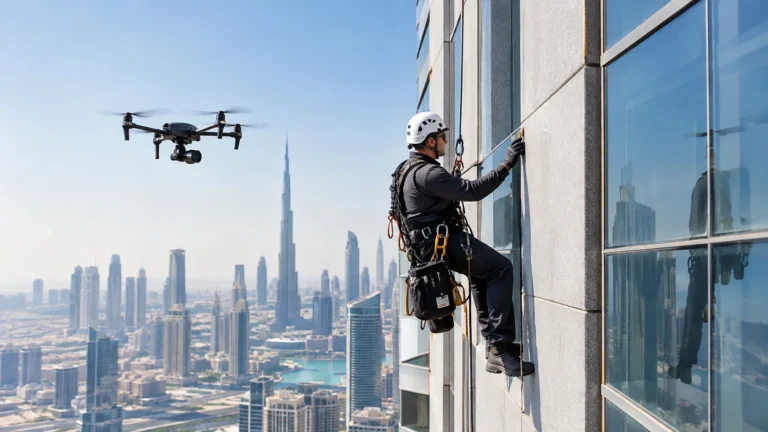
For Dubai high-rises, the main options include drones, industrial rope access, a building maintenance unit (BMU) and scaffolding. Each has a different purpose. A drone can quickly capture large areas of a façade. Rope access gives technicians close physical access. A BMU can provide controlled access where the building has a suitable system, while scaffolding creates a stable platform for longer inspection or repair work.
So, which is best? The answer depends on what you need to inspect and what you need to do afterwards.
What Are the Main High-Rise Façade Inspection Methods?
Before comparing costs or inspection speed, it helps to understand what each method actually does.
Drone Façade Inspection
A drone uses professional cameras to capture detailed images of a building exterior from multiple angles. It can cover large areas without installing scaffolding or placing an inspector beside every façade section.
Modern drone inspection can also incorporate thermal imaging and photogrammetry, depending on the project requirements. These technologies can help document defects, create detailed visual records and support further engineering assessment.
A drone is particularly useful when the first requirement is to understand where problems are located.
Rope Access Inspection
Industrial rope access allows trained technicians to reach difficult areas directly using ropes and associated equipment.
It is particularly useful when a defect requires close examination, physical testing or minor repair work. IRATA requires its member companies to employ appropriately qualified technicians and operate under documented rope-access procedures and controls.
This makes rope access a strong option when visual information alone is not enough.
BMU and Gondola Inspection
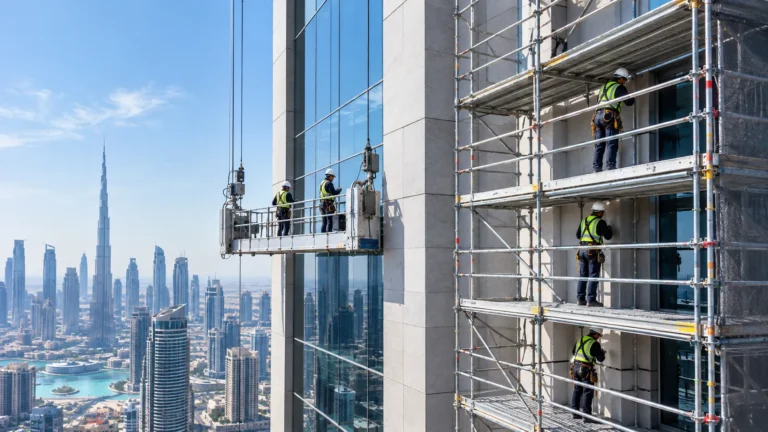
A building maintenance unit, often called a BMU or gondola system, is a building-mounted access system designed to allow personnel to reach exterior elevations.
Its usefulness depends heavily on the building. If a tower has a suitable and properly maintained BMU, it can provide controlled physical access for inspection and maintenance.
Scaffolding
Scaffolding creates a temporary working platform around selected areas or larger sections of a building.
Its main advantage is continuous physical access. This can be useful when inspection is combined with repair, replacement or other work that requires technicians to remain beside the façade for an extended period.
Drone vs Rope Access vs BMU vs Scaffolding
The best method depends on the inspection objective rather than simply the building height.
Factor | Drone | Rope Access | BMU | Scaffolding |
Large-area visual survey | Excellent | Moderate | Good | Good |
Close physical inspection | Limited | Excellent | Good | Excellent |
Inspection speed | Generally fast | Moderate | Moderate | Slower setup |
Difficult-area access | High | High | Building-dependent | Good |
Physical repairs | No | Yes | Yes, where suitable | Yes |
Setup requirements | Low to moderate | Moderate | Existing system required | High |
Weather dependency | High | High | High | Variable |
Occupant disruption | Usually low | Usually low | Moderate | Higher |
Digital documentation | Excellent | Good | Good | Good |
This table is a guide, not a universal ranking. Building geometry, façade materials, weather and the required inspection depth can change the most suitable option.
Which Method Is Fastest for a Dubai High-Rise?
For broad visual coverage, drone inspection is generally one of the quickest starting points.
A drone can capture multiple elevations without installing access equipment first. That can make it useful for an initial condition survey, especially when a building has many difficult-to-reach areas.
But speed should not be confused with completing the entire inspection programme.
For example, imagine a drone survey identifies ten areas with deteriorated sealant. If engineers need to physically examine or test those locations, rope access or a BMU may still be required.
The drone answers where we should look more closely. Physical access can then answer what exactly is happening there.
Which Method Is Safest?
There is no responsible basis for declaring one method universally safest.
Safety depends on the task, equipment, operator competence, site conditions, weather, planning and applicable controls.
For a drone operation, an inspection service provider must consider the equipment to be used, the location of the operation, people and property in the surrounding area, the airspace, and any permission that may be required.
For rope access, competent personnel, equipment checks, supervision, rescue planning and working-at-height procedures are essential. IRATA’s code of practice includes pre-use and detailed equipment inspection requirements, with detailed inspections carried out by competent persons at defined intervals.
BMU and scaffolding work also require suitable equipment, inspection, planning and trained personnel.
The practical lesson is simple: compare the complete work method, not just the equipment.
Have a question about your project?
Scaffolding vs Drone Inspection Cost
There is no reliable single price for scaffolding vs drone inspection cost in Dubai because the scope can vary greatly between buildings.
Drone inspection costs may be influenced by:
- Building height and size
- Number of elevations
- Required image resolution
- Thermal imaging
- Photogrammetry or 3D modelling
- Reporting requirements
- Site and flight conditions
Scaffolding costs may include:
- Installation and dismantling
- Rental period
- Labour
- Safety systems
- Access requirements
- Site logistics
For this reason, comparing only the initial quotation can be misleading. The better question is:
What will the complete inspection require from start to finish?
A low-cost visual survey may not remain low-cost if extensive physical access is needed afterwards.
BMU vs Drone Building Inspection: Which Should You Choose?
The BMU vs drone building inspection decision often comes down to whether you need broad visual coverage or direct physical access.
Choose a drone when:
- You need to survey large façade areas quickly.
- You want detailed photographic records.
- You need to identify priority defects.
- Physical contact is not initially required.
Choose a BMU when:
- The building has a suitable permanent BMU.
- Close access is required.
- Technicians need to work directly on façade components.
- Inspection and maintenance are being performed together.
In many cases, there is no need to choose only one.
A drone can first identify areas requiring attention, while a BMU can then provide controlled physical access to selected locations.
When Is Rope Access Better Than a Drone?
Rope access may be better when a technician needs to get close to a specific defect.
If a cladding panel raises concerns during a FAIS, several follow-up actions may involve pull-testing, tap-testing, or a close examination of the fixings.
That is where professional rope access inspection becomes valuable.
Baseera 360 describes its rope-access service as a close-up inspection method for defects first identified through drone or ground-level surveys, including physical checks of cladding panels, anchors and sealant joints.
This illustrates an important point: drone and rope access do not have to compete. They can work as two stages of the same inspection process.
When Should You Use a Hybrid Inspection Approach?
For some Dubai high-rise buildings, combining methods can be the most practical option.
A typical process could be:
Step 1: Survey the façade using a drone.
Step 2: Record visible defects and their locations.
Step 3: Review the findings with the relevant engineering professional.
Step 4: Use rope access or BMU access for areas requiring closer physical assessment.
Step 5: Carry out additional testing or repairs where required.
Step 6: Capture follow-up imagery to document completed work.
This approach can reduce unnecessary physical access while still allowing technicians to investigate defects that cannot be confirmed from aerial imagery alone.
Dubai Regulations and Professional Inspection
A drone inspection does not merely involve ‘flight around the tower’.
The GCAA regulates professional unmanned aerial vehicle operations, and inspection and survey operations are considered professional or special operations and are subject to the applicable regulations and permissions.
Dubai’s Law No. 3 of 2026 concerning Quality and Safety of Buildings also stipulates that qualifying building appraisals need to include appraisal of the structural integrity and external wall cladding systems, with evaluation conducted by a qualified Engineering Firm.
This matters because a drone image by itself is not the same thing as a complete engineering assessment.
The inspection method and reporting process should match the actual regulatory and technical requirements.
How to Choose the Right High-Rise Access Method in Dubai
Use this simple decision guide:
Choose a drone when your priority is broad visual coverage, defect documentation and rapid initial assessment.
Choose rope access when your priority is close physical inspection, testing or targeted repair.
Choose a BMU when your building has a suitable permanent access system and technicians need controlled façade access.
Choose scaffolding when extensive physical access is needed for longer inspection or repair work.
Choose a combination when you need both broad coverage and detailed physical investigation.
For a wider explanation of inspection technology, façade defects, thermal imaging, regulations and reporting, see our drone façade inspection comparison within the complete guide to drone facade inspection.
The Right Method Is the One That Answers the Right Question
There is no universal winner between drones, rope access, BMUs and scaffolding.
The best high-rise access methods Dubai property teams can use depend on the building, façade, inspection objective, site conditions and whether the work requires physical contact.
For many projects, a drone is an effective first step because it can quickly show where attention is needed. Rope access or a BMU can then provide close access where necessary, while scaffolding remains useful for larger repair and maintenance programmes.
The goal is not simply to reach every part of a building. It is to collect reliable information, identify genuine risks and give the building team a clear basis for its next decision.
Need Help Choosing an Inspection Method?
Baseera 360 combines drone façade inspection with rope access and BMU-based inspection, allowing the inspection method to be matched to the actual site requirement. Its published service information also states that inspection datasets are reviewed by professionally registered engineers.
Contact our team to discuss your Dubai high-rise, façade type and inspection requirements.