

Thermal Imaging Water Leak Detection Dubai: Finding the Facade Leak Source
Objective: You’ll learn how thermal scans trace leaks, where they fall short, and what to ask a surveyor before you pay for repairs.
Key takeaways
- A stain shows where water ended up, not where it came in.
- A thermal camera reads surface temperature, not water. Treat findings as strong clues, then confirm them.
- Drones suit whole elevations. Windows and joints usually need a close-up check.
- A good report shows conditions on the day, paired images, proof of source and ranked actions.
- Start a leak log today. It costs nothing.
Introduction
You fix the stain, repaint the ceiling, and a few weeks later it’s back.
Water in a facade doesn’t stay put. It gets in through a failed joint, runs behind the cladding and shows up metres away. That’s why patch repairs so often fail, and why tenants keep calling.
Then a big storm arrives. In April 2024, the UAE saw its heaviest rainfall on record, and the National Centre of Meteorology reported around 254 mm in under 24 hours in Al Ain. Weather like that tests every joint on a building.
The fix starts with finding the source. Thermal imaging water leak detection Dubai teams use lets you scan a whole elevation first and spot the wet zones before you spend a dirham on repairs.
Did you know? ASTM’s guide E3216 says infrared thermography can survey large areas, such as walls and roofs, in a short time, but results should be checked with direct measurement.
1. What is facade water leakage detection?
Facade water leakage detection means finding where water gets through a building’s outer shell, called the building envelope, and tracing where it goes inside. That shell includes cladding, curtain walls, glazing, sealant joints and roof-to-wall junctions.
The goal isn’t spotting damp. It’s following the leak path back to the source of leakage, so the repair lands in the right place. Good surveys use non-destructive testing, which means nothing gets broken open just to look.
2. Why Dubai facades are hard to read
Water takes the easiest route in, then follows gaps behind cladding or inside cavities until a ledge or gravity stops it. Water ingress after rain in Dubai towers might start two floors up and a few metres sideways from the stain.
Add strong sun, hot days, humidity and constant material movement, and sealants and joints take a beating. Common weak spots:
- Sealant joints
- Window and glazing edges
- Cladding junctions
- Parapets and roof-to-wall details
3. How thermal imaging finds moisture
A thermal camera doesn’t see water. It reads surface temperature. Wet materials often heat and cool differently from dry ones, partly because evaporating water takes heat with it. So a damp area can look cooler or warmer than its surroundings, depending on the time of day and the weather. We call that a thermal anomaly.
A thermal image is a map of clues. ASTM notes that anomalies may help assess moisture in building materials, but readings at sample locations should confirm them. ISO 6781-1:2023 sets out procedures for infrared surveys that find heat, air and moisture irregularities in buildings.
Which method does what?
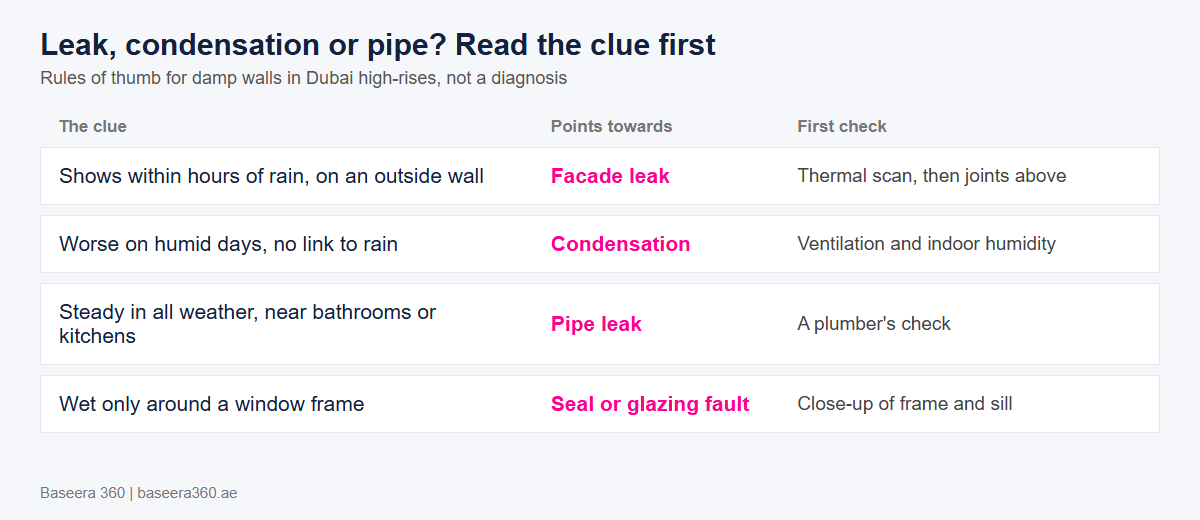
- Shows within hours of rain, on an outside wall: facade leak. First check: thermal scan, then a close look at joints above.
- Worse on humid days, no link to rain, cold surfaces: condensation. First check: ventilation and indoor humidity.
- Steady in all weather, near bathrooms or kitchens: pipe leak. First check: a plumber’s check.
- Wet only around a window frame: seal or glazing fault. First check: close-up of frame and sill.
No single method gives you the full answer. Together, they do.
4. Damp walls in high-rises: leak, condensation or pipe?
If you are tracking down damp walls in high-rise Dubai apartments, start with one question: when does it appear? Timing gives away a lot. These are rules of thumb, not a diagnosis.
Windows have a catch. For window leak detection in Dubai buildings, remember that glass reflects infrared, so a camera can mislead you on glazing. Frames, gaskets and sills usually need a hands-on look.
Your 10-minute leak log
- The date and time of the rain, and wind direction if you know it
- The room and floor
- A photo of the stain next to a coin
- How long it took to appear, and whether it dried
You can find our other free templates on the free inspection checklists and templates page.
5. Drone, handheld or rope access
- drone facade inspection a fast view of tall elevations with no scaffolding and no shutdown.
- Handheld thermography indoors: helps trace damp patches back towards the envelope.
- Rope access and BMU teams get close to flagged spots to test, seal and clean. Our IRATA-certified technicians go straight to the defects our drones flag.
Results depend on conditions such as temperature difference, sunlight and wind. Ask your surveyor to record them in the report.
Tenants complaining after every storm?
Send us your site, emirate and timeline. We can scan the elevation first and show you where the water really enters.
Request a sample report6. Our step-by-step process
- Brief. You tell us the site, service and timeline. We confirm scope, emirate and deliverables within 24 hours.
- Permits. We manage GCAA, DCAA, Ministry of Defence and emirate-level clearances.
- Capture. Trained specialists arrive with the right drone, sensor or rope access set-up. Most inspections finish in a single day.
- Close checks. Flagged zones get a hands-on look before anyone calls them leaks.
- Engineer review. A professionally registered engineer reviews and signs off the data.
- Delivery. You receive tagged photos, thermal maps and prioritised recommendations through our secure client portal.
A made-up but common scenario: you manage a 40-storey tower, and tenants on three floors complain after every storm. A scan might show the cool patches lining up under one joint, not at the stains. Now you repair one line, not three flats.
7. What to check before you hire
Credentials. Look for GCAA and DCAA approvals, certified thermography and a registered engineer’s sign-off. We hold GCAA and DCAA approvals and use ITC-certified thermography.
The report. A solid thermal imaging water leak detection Dubai report shows conditions on the day, thermal and normal photos side by side, proof of the source and ranked actions.
Red flags:
- Colourful images with no checks behind them
- A promise to find every leak
- No mention of limits
Conclusion: find the leak, not just the stain
Water travels, cameras give clues, and proof settles it. If you are comparing options for thermal imaging water leak detection Dubai owners can trust, start with a scan, then ask for proof before anyone picks up a sealant gun.
Next step: speak to a Survey Engineer at Baseera 360 or request a sample report. Tell us your site, emirate and timeline, and we’ll confirm the scope within 24 hours.
Find the leak before you pay for repairs
Speak to a survey engineer at Baseera 360. We confirm the scope within 24 hours.
Request a sample reportFAQs
1. Can thermal imaging detect water leaks in walls?
It can show temperature patterns linked to moisture. It reads surface temperature, so a moisture reading or water test should confirm the source.
2. Can a drone find window leaks on a high-rise?
A drone is good at spotting suspect zones across a whole elevation. Glass reflects infrared, so window leaks usually need a close-up check.
3. What is the best time to scan a facade in Dubai?
When the facade is warming or cooling enough for wet and dry areas to look different. Your thermographer should record conditions and explain the timing.
4. Do you need a permit to fly a drone for a facade survey in Dubai?
Yes, aviation and airspace approvals apply. We handle GCAA, DCAA and related clearances for you.
5. How do you confirm where a facade leak comes from?
You combine the thermal scan with close-up inspection and testing at the flagged points. Only then is the source proven.
